
What is the thickness of a metal label?
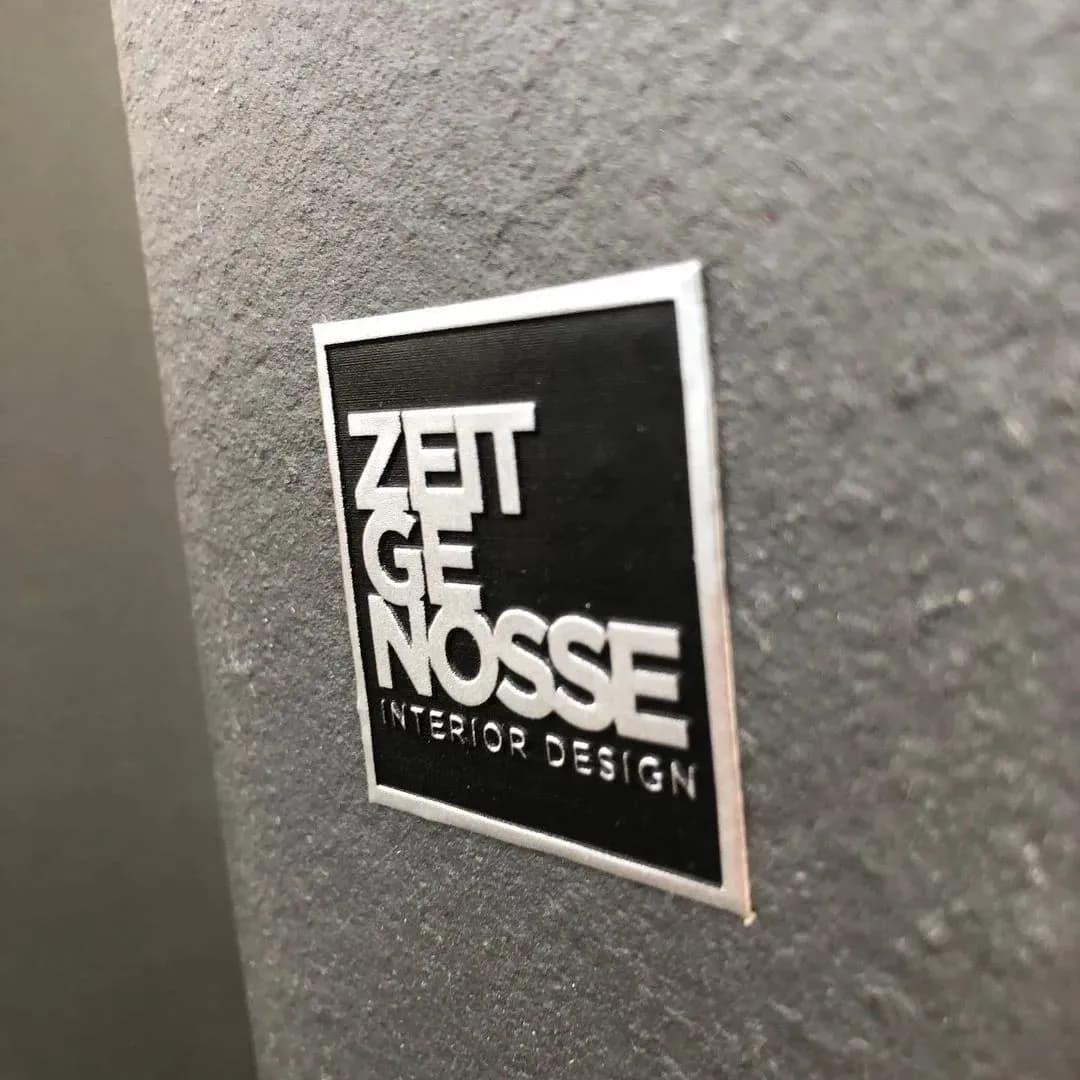
The thickness of a metal label is 1 millimetre. This size includes the thin relief layer and the self-adhesive layer on the back. That 1mm makes the label flexible enough to bend with curved surfaces, a crucial advantage you do not have with stiffer alternatives.
Because we have produced this since 2021 for more than 1,200 business customers in 19 countries, we know exactly when this thickness is sufficient and when you should look at another product.
Key features
- 1 mm thickness: includes relief, adhesive and metallic layer, sufficient for most branding applications
- Flexibility: bends with curves down to about 5–10 cm diameter; rigid substrates cannot always handle it
- Material thickness varies: tin 0.16 mm, copper and aluminium 0.10 mm, brass only 0.06 mm, so the ‘1 mm’ includes protection and adhesive
- Self-adhesive as standard: Lohmann adhesive for aluminium and tin, 3M adhesive for copper and brass
- Removable: use a sticker remover or hairdryer; no scratches or glue residue left behind
- Minimum order 250 pieces: technically can be lower, but unit price then rises to about €1,27 (at 250 pieces) versus €0,60 from 2,500 pieces, a price example
- Lead time 4–5 weeks: after approval of the free digital preview; no physical samples, but a test pack for new customers

Why exactly 1 millimetre?
We choose 1 mm because it offers the optimal balance between durability and flexibility. A label thinner than 1 mm feels too fragile and tears easily during application. Thicker than 1 mm, such as the 2–3 mm of our hard badges, leads to stiffness and cannot bend with round shapes. More guides on this topic are in the category Metal labels. Also read our guide on metal label oxidation.
In practice we recommend labels for products with curved surfaces (bottles, frames, tubes), and badges for flat mounting. A bike manufacturer almost always chooses the metal label because a frame or mudguard is not straight; only the thin, flexible label follows that curve seamlessly.
The real material thickness, so the pure metal without relief and adhesive, is much thinner: tin for example only 0.16 mm. That thinner metallic layer is why we choose exactly the right adhesive per material. For large copper or brass labels we sometimes use a thicker Lohmann adhesive, because otherwise the metal can lift at the edges due to surface tension.
How do you choose the right material at 1 mm thickness?
Each metal behaves differently at this thickness. Aluminium remains the most stable outdoors, because it does not oxidise, it stays grey-metallic or can be anodised. Tin, copper and brass oxidise over time, even with the protective layer. A dark patina on tin is for example beautiful, but it happens by itself outdoors. All versions and prices are on the page 1 mm metal labels.

Do your customers want metallic shine without oxidation? Choose aluminium. Is oxidation unwanted? Then still aluminium, or a printed top layer. But if you put a print layer on it, you do not see the bare metal, and where the metal is still exposed (edges, die-cut openings) it can still discolour partly.
From experience we know many entrepreneurs consider tin because it is cheaper, but the advice is: for outdoor use do not choose tin. Aluminium costs little more and saves you years of worry about colour quality.
Flexibility in practice: which curves fit?
That 1 mm label bends to a diameter of roughly 5–10 cm, depending on how stiff the material is. Tin and aluminium are more flexible than copper or brass. A bottle with a diameter of 8 cm: no problem. A pipette or a thin handle: also fine. A rectangular box: of course. Also read our guide on metal label finishing.
Where it gets tricky is very tightly curved. If your team applies the label on a tube with a diameter of 2–3 cm, it can tear. Then we recommend: do not wrap the label all the way around, or choose screw mounting.
That brings us to fixing. Self-adhesive works on most materials, but on oiled or waxed wood it sticks much worse. There you could consider a screw hole or a magnet instead of self-adhesive, or switch to our hard badges with pre-drilled hole.
Comparison: label vs badge vs alternative
You can see the table above. In short: choose the metal label (1 mm) for anything that bends. Choose the badge (2–3 mm) if you want a stronger 3D effect or if the substrate is absolutely rigid and flat. A badge also has less flexibility in minimum order: badges really do not start below 250 pieces, while labels can technically be lower (but more expensive).

A third option, stainless steel nameplates for industry, is not yet standard online, but we are working on it. Aluminium labels are currently the closest for heavy industrial marking.
Who is 1 mm thickness suitable for?
Bicycle manufacturers and wheel producers
You almost always choose the metal label. A frame tube is curved, a mudguard too, the 1 mm flexibility naturally follows that curve. With labels for bikes and accessories you can keep the same branding quality from prototype to volume production. More background on oxidation can be found on Wikipedia.
Furniture makers and woodworkers
A designer chair, a vintage cabinet, a wooden instrument case, that calls for a beautiful metal label. Note: on rough or waxed wood, self-adhesive sticks worse. Solution: for screw fixing simply pre-cut a small hole, or choose our hard badge. Labels for furniture give that premium feel without complicated mounting.
Perfume, cosmetics and wine producers
Flacons and bottles are round. Here the metal label really shines. Aluminium is your best choice: no oxidation worries, stays purely metallic. Also: large labels (up to 180–220 mm) we charge per cm² at €0,04/cm². For perfume bottles and for wine bottles we have a lot of experience; send your requirements and we will give you a tailored quote.
Practical advice: how to apply the label well
A common mistake is applying the label under tension, as if you are pulling it tight around a tube. Do not do that. Pinch gently in the middle and set down the label so it aligns by itself. Then press gently smooth from the centre to the edges.
Glue residue? That happens if you try to peel the label off too carefully. Use a sticker remover, hairdryer, or even warm water. No sharp tools, or you will get scratches.
The 3D relief becomes more visible as the contrast increases, so between the relief height and the flat areas. White relief on a dark background looks better than relief and background in the same colour.
Lead time and order limits
We work with a minimum order of 250 pieces (or 100 for your first order if you are new). The lead time is 4–5 weeks after approval of your free digital preview, no physical samples, but a test pack if you want.
What does that price example cost? An aluminium label of about 3.5 cm size costs around €1,27 each at 250 pieces. If you order 2,500 pieces, that drops to €0,60 each. Steps are 250 → 500 → 1,000 → 2,500 pieces. Exact prices depend on size, shape, material and quantity, see our price calculator and request a tailored quote.
Can we go lower than 250? Yes, but then you pay more per piece, a common mistake is thinking 100 pieces are “almost free”. The opposite is true: 100 pieces cost 2–3x more per piece than 250 pieces, because die-cut and setup stay the same.
Conclusion
Yes, 1 mm thickness is standard suitable for labels on curved or flat surfaces, as long as you choose the right material. For outdoor use: aluminium. For indoor use on premium furniture, musical instruments or flacons: tin, copper or brass, depending on the aesthetic effect you want. Self-adhesive works in 90% of cases; on oiled wood or very rough surfaces you should consider screws or magnets.
The advice if in doubt: send your brief to us, since 2021 we have made over 800,000 labels for customers in 19+ countries, and 95% order again. A free digital preview is included. We explain what does and does not work, and you see the design before production.
