

What are bike labels for bike shops?
Bike labels for bike shops are thin (1 mm), flexible metal labels with your shop or brand name, fixed to sold bikes, usually on the frame, mudguard or head tube. They serve two goals at once: establish your brand and set your stock apart professionally from competitors who still use ordinary stickers. A good bike label looks premium and matches the price range of modern (often expensive) bike models.
Key features
- Material & thickness: 1 mm thin, flexible aluminium, tin, copper or brass, 100% the stated metal (not mixed)
- 3D relief: every label has a subtle relief that gives tactile depth; your brand literally stands out
- Fixing: self-adhesive (standard) on aluminium or steel bike parts; later removable with an adhesive remover without scratches
- Outdoor resistant: choose aluminium (does not oxidise); tin, copper or brass turn dull and oxidise after months, so not suited for outdoor use
- Minimum run: 250 units (or 100 units for first orders); lead time 4–5 weeks after approval of digital preview
- Price example: about €1.27 per label at 250 units, dropping to €0.60 per piece at 2,500+ units (excl. one-off die-cut/printing costs)
- Design & preview: free digital preview before production; no physical pre-production samples, but a small test pack is available
- Brand certification: Schild Inc has worked with 500+ bike partners since 2021 (including BikeTotaal, Azor, VMG) and has supplied over 800,000 metal labels in Europe

Why bike shops choose metal labels instead of badges
A common question: why not a hard 3 mm badge? The answer is simple: a bike has many curved surfaces. Frames, mudguards and the head tube are never flat, and a rigid 3 mm label simply does not follow that curve, you get gaps and buckling. A flexible 1 mm label bends with the aluminium bike part without stress and looks neat. More guides on this topic are in the category Metal labels.
That is why almost all bike manufacturers who put their brand on frames choose the thin metal label. A hard badge suits much flatter applications (think furniture or rectangular equipment), but not bike frames.
At Schild Inc we see this principle works very well in practice: over 95% of our customers reorder, and many bike partners roll out their labels on hundreds of bike models per year.
Which material should you choose for your bike labels?
That depends on your goal. The choice sets the look and also how long your label keeps looking good. All variants and prices are on the page bike labels and accessories.

Aluminium: the preferred choice for bike shops
Aluminium is the most popular material for bike labels. It does not turn brown or dull outdoors, it stays grey and stable, and its weight suits modern bikes perfectly. Do your bikes go outside in winter or in the rain? Aluminium gives no issues at all. Schild Inc adds a protective layer, so your label lasts for years without noticeable wear. Read our guide on bike label outdoor.
Tin, copper or brass: vintage look with limits
Tin, copper and brass have a warmer, more vintage character, red for copper, gold-like for brass. BUT: these three metals oxidise outdoors over time, even with the protective layer. After a few months in the rain they develop a grey or brown patina. It is not true rust, but the metal colour fades. That is why we do not recommend tin, copper and brass for bikes that stand outside or are often exposed to weather. For this sector we have a separate page: bike labels and accessories.

Exception: a printed top layer protects better, but then you do not see the bare metal (or hardly), so the benefits of the metal effect are gone.
From experience we know that bike shops that choose tin or brass later ask to replace the label because it no longer looks premium. Our advice: choose aluminium unless you need a very specific vintage look and the bike stands mainly indoors.
How do you order bike labels for your shop?
The steps are simple, but it helps to think through your brand and quantity in advance. Read our guide on bike frame label.
1. Decide your quantity and budget
We see bike shops usually start with 250 to 500 labels, enough for a season or two without much storage cost. Even below 250 units is possible, but then the price per label rises sharply. At 250 units you are around €1.27 per label (price example; exact depends on size and shape). At 500 units you already drop to about €0.75 each. Request a tailored quote on our page for bike labels & accessories, where you can see the exact price breaks for your configuration.
2. Design your label
Your label must fit the bike part where you want to place it. A head tube is small (often 4–5 cm), the side of the frame is larger. Take your measurement, make a sketch (or let Schild Inc help; our design advisors are happy to do this). Make sure your logo and text remain sharply legible at your chosen size.
3. Choose your material and finish
Aluminium as standard, unless for marketing reasons you go for a warmer metal (and are prepared for oxidation). Also ask about contrast options: the stronger the 3D relief is finished (light and dark areas), the more your brand stands out.
4. Receive your free digital preview
We create a free digital preview for every order (colour, side, typeface). That takes a few days. Once you approve, we go to production, no long negotiations, no physical samples shipped back and forth.
5. Wait 4–5 weeks for delivery
That is the standard lead time. Rush is possible to a limited extent; ask about it.
Tip: many bike shops organise their labels on the same day they receive new stock, so the label is already on the frame when the customer walks in. It looks professional and stands out at once.
Two real-world examples of bike shops with metal labels
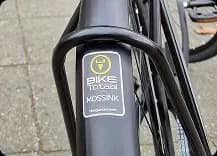
BikeTotaal, a mid-sized bike shop in the Netherlands, ordered 500 aluminium labels (3.5 cm round) with their green brand name. They stuck them on every mudguard, and customers could immediately see it was a serious, professional shop. Not a cheap sticker, but a real metal brand. Within a year they had easily earned back their MOQ thanks to brand recognition.
Another example: Azor, a classic wheel and frame builder, used copper labels (with a vintage look) on their expertly built frames. Although copper labels oxidise outdoors, Azor bikes usually stand in a showroom or garage, not permanently outside. For them that warm copper colour was perfect for their craftsmanship story.
These examples show it is not only about technique: a bike label is a marketing choice.
Fixing: how do you attach a bike label properly?
The standard is self-adhesive on the aluminium or steel bike part. Schild Inc adds two types of adhesive: More background on aluminium can be found on Wikipedia.
- Yellow Lohmann adhesive (Germany) for aluminium and tin; it bonds excellently and lasts for years.
- 3M adhesive for copper and brass, a bit more flexibility, especially on larger labels.
For very large copper or brass labels we sometimes use a thicker Lohmann adhesive, because surface tension otherwise lifts the edges.
Always apply the label to a clean, dry surface. A quick wipe with a dry cloth is enough. Press the label on firmly and let it dry for 24 hours before you transport the bike or put it under water.
Can you remove the label later?
Yes, and that is actually an advantage, not a problem. Use an adhesive remover (no sharp tools), and the label comes off with some effort. No glue residue or scratches remain on the frame. That is why bike labels are also useful for shops that rent out bikes: labels are removable if you resell the bike or send it for maintenance.
Do you want the label to be permanent? Ask for our non-standard strong-adhesive option (on request), then the label is fixed for good.
How long do bike labels last?
That depends on three things: material, weather and care.
Aluminium outdoors: 5–7 years without visible wear. The colour stays grey and stable. After 7 years it may become slightly matt, but it stays intact. This is why we recommend it for bikes that really live outdoors.
Tin, copper, brass outdoors: 6–12 months before oxidation becomes visible. You then see grey or brown spots. The oxidation does not progress through (the label does not get holes), but aesthetically it quickly loses its shine.
Metal labels with a printed top layer: 3–5 years outdoors. The print protects the metal underneath, but where the bare metal is exposed (for example along the edges), some oxidation can occur.
Self-adhesive fixing: 5–7 years on a dry bike part. In a wet climate or lots of sunlight it may release earlier. An annual check is sensible.
A small practical maintenance tip: if you want to refresh your label after years, gently remove the old label and apply a new one. You do not need to respray or completely refurbish the bike.
Who are bike labels for?
Bike shop owners with branding needs
If you sell bikes and want customers to see your shop or brand name on their bike, metal labels are an effective tool. They cost less than a full respray, look much more professional than stickers, and are flexible enough for any bike part, from frame to mudguard to chain guard.
Bike manufacturers and builders
Both big brands (that make millions of bikes per year) and small, skilled frame builders use these labels. They know their product is premium, and the label should reflect that. A cheap sticker would not fit.
Bike rental and lease companies
If you run hundreds of hire bikes and want users to recognise them, labels are very useful. They are durable, make your brand stand out, and can be removed later if you sell the bike or retire it from the fleet. Also easy to swap during rebranding.
E-bike shops
E-bikes are expensive; a label suits that price range better than a cheap sticker. Many e-bike shops work with private labels to build their brand. Here we especially see demand for aluminium (for durability) and strong adhesive (because owners want to keep their e-bike).
Conclusion: yes, metal labels are the right choice for your bike shop
If you sell bikes and want to put your brand on every frame professionally, 1 mm metal labels are the answer. They are flexible enough for any bike part, look premium, and protect your brand name for years, especially in aluminium. The minimum run of 250 units is low enough for small shops, and a price example of €1.27 per label is reasonable for a real metal brand instead of a sticker.
The only drawback: you need to wait 4–5 weeks. So order in time, not when your stock is already on the shop floor. With a bit of planning this is no problem.
The question is not whether to get labels, it is when you will get to it. Many of our bike shops say: “Why didn’t we do this earlier?” You could say from us that 95% of customers reorder, and that since 2021 we have delivered over 800,000 labels to 1,200+ partners in 19+ countries.
