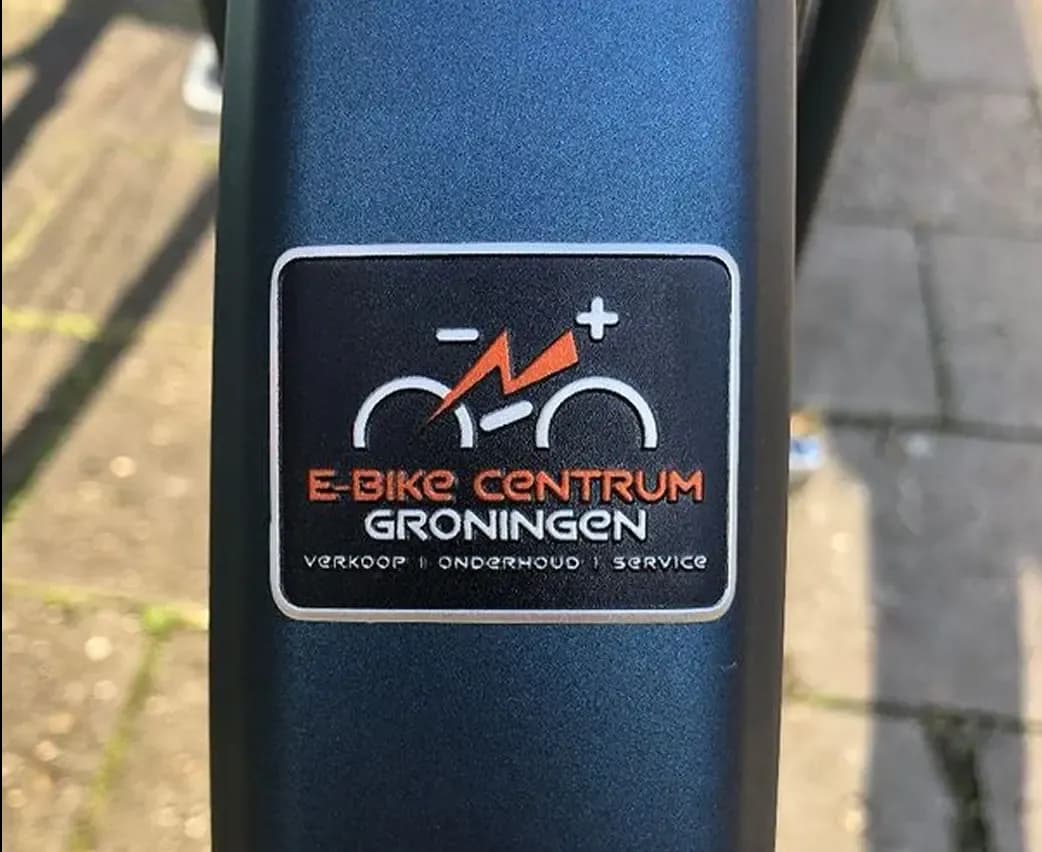


Metal bike labels are thin, flexible 1 mm brand labels that you stick to the frame, mudguard or handlebar of a bike. They are made from 100% metal (tin, copper, brass or aluminium) with integrated adhesive and a subtle 3D relief, so they look like a premium brand detail, not a regular sticker.
Bikes have become more expensive and refined, especially e-bikes and gravel bikes. A cheap plastic sticker does not fit that. A metal label gives your bike instant character and sets your brand apart from competitors. The flexible design also follows the curves of your frame or mudguard, while a rigid hard badge simply will not fit.
Key features
- Thickness: 1 mm, including relief and adhesive, flexible and bendable
- Materials: 100% tin, copper, brass or aluminium of your choice
- Suitable for outdoors: aluminium (does not oxidise); tin/copper/brass oxidise over time
- Fixing: self-adhesive or optional permanent adhesive (on request)
- 3D effect: present thanks to pressed relief; contrast determines visibility
- Removable: with a sticker remover without scratches or adhesive residue
- Minimum order: 250 pieces; below that is possible, but the unit price rises
- Lead time: 4–5 weeks after approval of the free digital preview
Why aluminium is the right choice for outdoors
For bikes there is one golden rule: aluminium. That sounds simple, but the difference between materials is essential. More guides on this topic are in the category Metal labels.

Tin, copper and brass oxidise outdoors over time, even with a protective coating. After a few months you see darker spots, a greenish deposit or brown patinas. This is not a defect, but inevitable. For a brand detail on your bike, which stands in rain and sun, that is not ideal.
Aluminium remains stable. It does not discolour, does not turn green, and keeps its original shine for years. If you add a printed top layer (for example your logo in one colour), that adds protection, but you still do not see the bare metal, and where the metal remains exposed it can still partly oxidise. An aluminium label without print is, by contrast, a long-term investment.
From experience we know that almost all bike manufacturers and shops, more than 500 partners such as BikeTotaal, Azor and VMG, choose aluminium. They understand that durability and appearance go hand in hand.
The flexible design: why a metal label, not a badge
A bike brand belongs on the tube, the mudguard or the seatpost, so on curved surfaces. A rigid hard 3 mm badge does not fit there. That badge would leave gaps or would not sit well on the curve. Read our guide on bike labels for bike shops.
A 1 mm metal label is flexible. It bends with the curve of your frame and adheres perfectly. A common mistake is to assume a badge can do the same job, but physics works against you. A rigid badge is for flat parts, and those are rare on a bike.
The adhesive adhesion of a metal label is yellow Lohmann (Germany) for aluminium and tin, and 3M for copper and brass. These adhesives are optimised for the surface type (painted metal of a bike frame). They hold for years, and if you later remove the label (for example for a new design), you can carefully use a sticker remover, no scratches, no adhesive residue.
Size, shape and price: what you need to know
Metal bike labels are custom-made. Most brands choose a rectangle of 3–5 cm, but round, angular or asymmetrical shapes are just as possible. Large labels (above 80–100 mm²) are charged per cm² at €0,04. All versions and prices are on the page bike labels and accessories.

A price example: an aluminium label of about 3,5 cm costs you around €1,27 each for 250 pieces. Order 2.500 pieces and that drops to about €0,60 each. There are one-off die-cut and print costs on top. Small runs (50–100 pieces) are also possible, but per piece it quickly becomes two to three times as expensive. So our advice is: if in doubt, order at least 250 pieces. That is standard, and the margin per unit is much better.
Schild Inc. has produced over 800,000 metal labels since 2021 for more than 1,200 business customers in 19+ countries, mostly in Europe. Your order is prepared in Almere and shipped to you. The lead time is 4–5 weeks after approval of the free digital preview. You always get that preview free; you see exactly how your label will look before the machine starts.
3D relief and finish: subtlety is the secret
A metal bike label has a pressed 3D relief, just like our hard badges. The difference? The relief of a label is more subtle because the label is thinner. It is still noticeable, especially when you hold it against the light or run your fingers over it. Read our guide on bike label for outdoors.
Visibility depends on contrast. If your logo is silver on silver (aluminium), you mainly see the shadows. If you choose a printed top layer in a contrast colour, black, white, blue, the relief stands out. Many makers combine both: matte print with shiny metal underneath, so the 3D effect becomes even stronger.
From experience we recommend: let the digital preview clearly show how the relief comes out. Some designs work better with more contrast; others with subtlety. We are happy to help with that.
Removal and reuse: flexibility without damage
One advantage of self-adhesive: the label is removable later. Say your bike gets a new name, or you want to update the design. With a sticker remover you can gently loosen the label, no sharp objects, otherwise you will damage the paint of your frame. The label is hard to remove, but it can be done. For this sector we have a separate page: bike labels and accessories.

Do you want the label to be permanently fixed? On request we supply a non-standard strong-adhesive option. That will not come off, or only with great difficulty. Handy if you have a limited run and want no risk of loss. More background on aluminium can be found on Wikipedia.
Who are metal bike labels for?
Bike manufacturers and brand programmes
Bike makers want to set their brand apart. A metal label on the seatpost or tube frame is a visual statement. It says: this is not a mass product, this is care and attention. Manufacturers almost always choose aluminium and self-adhesive, so assembly is efficient. Schild Inc. works with bike builders in the Netherlands, Belgium and Germany, some order 250 pieces per season, others 5,000+.
Bike shops and custom builders
A local bike shop or custom builder wants to brand its service. A sticker on your name feels cheap; a metal label feels premium. "Built by [your name], Amsterdam" on the seatpost, that speaks. Many bike shops start with 250–500 pieces for their house brand.
E-bike brands and high-end manufacturers
E-bikes cost €2.000–€10.000. A plastic sticker does not belong there. An aluminium metal label fits that price range perfectly and reflects that investment. High-end brands (Vanmoof, Urban Arrow, other Dutch and German manufacturers) use metal labels as standard.
Comparison: metal label vs standard sticker vs hard badge
A standard plastic sticker is cheap, but it fades quickly in the sun and looks worn after two years. A metal label stays good-looking for years and feels premium. The unit price is higher, but the added value justifies it, especially for e-bikes.
A hard badge (3 mm, zinc alloy) is thicker and stronger, but it is rigid. It does not fit on a bike frame (which is curved). A badge belongs on a flat surface (for example a brand plate on a door) or on a part you screw on. For bike labels and accessories we always choose the flexible metal label.
Materials under the microscope: tin, copper, brass and aluminium
Aluminium is your first choice for outdoors. Tin looks vintage and elegant, but oxidises quickly. Copper and brass give a warm, classic look, but they too show spots and patina after months outside.
Patina is sometimes seen as a plus (vintage look), but on a bike you park outside most customers do not want that. Our advice: choose aluminium. It is stable, stays shiny, and you can still paint it or rebrand it later without risk.
The actual material thickness differs per metal: tin 0,16 mm, aluminium and copper 0,10 mm, brass only 0,06 mm, the '1 mm' total includes the relief and adhesive layer. This makes no practical difference for strength, but it explains why tin can have a slightly fuller relief.
Practical steps: from design to order
Start with your logo or brand detail. Our advice: keep it simple. A complex design does not work well in a small size, lines cannot be too thin, text becomes unreadable. If your logo is 50×30 mm, that is perfect.
Email your design (PNG or PDF, one colour or multi-colour) to Schild Inc. See our custom metal labels or request a quote. You will get a digital preview almost immediately. Good? Then confirm the order quantity (250+), the material (aluminium for outdoors), and you are set. Four to five weeks later you have your labels.
For a first trial we offer a test pack of 50–100 pieces, cheaper per piece than if you were to order, but more expensive than large volumes. This is ideal if you want to test the label on your bike first before you order 1,000 pieces.
Why choose Schild Inc. for metal bike labels
Schild Inc. makes metal labels in Europe (Almere, the Netherlands). No middlemen, no long shipments from Asia. 95% of our customers order again, and we have a Google rating of 4.8 stars. We produce small and large runs, and we know bikes. We know how materials behave in wind and weather, and which adhesive works on which frame.
One advantage: you get support close to home. Questions about your label? We help by email or phone, not via a chatbot on another continent.
Conclusion
Yes, metal bike labels are suitable for your bike, especially if it is an e-bike or high-end model. Choose aluminium for durability outdoors, keep the design simple and large enough to see, and order at least 250 pieces. The unit price pays off quickly, especially compared to the added value the label gives your brand. A metal label does not look like a sticker, it looks like craftsmanship.
