
What is a metal label?
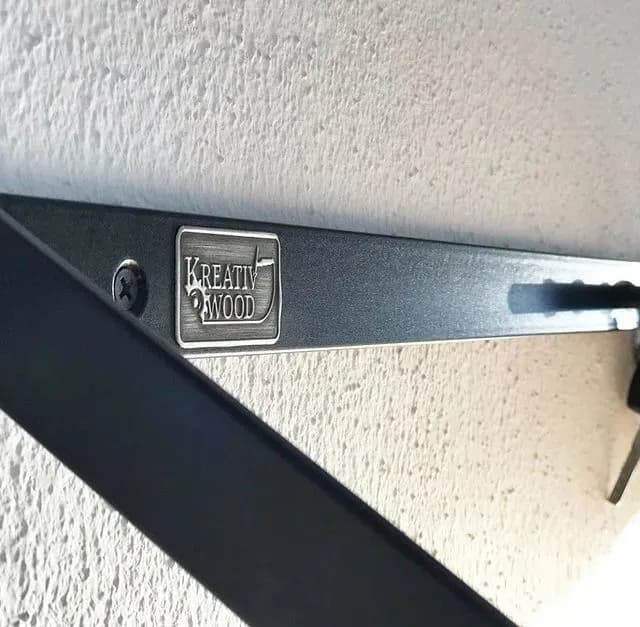
A metal label is a nameplate of about 1 mm thin, flexible metal that you attach to a product with self-adhesive, a magnet or by screw mounting. It is made from 100% pure metal, tin, copper, brass or aluminium, and often includes 3D relief and a protective layer. Since 2021 Schild Inc. has produced over 800,000 metal labels for more than 1,200 business customers in 19+ countries.
Key features
- Material thickness: 1 mm total (including 3D relief and adhesive); the actual metal ranges from 0.06 mm (brass) to 0.16 mm (tin)
- Four material choices: tin, copper, brass, aluminium, each with its own colour character and oxidation behaviour
- Flexible: bends with curves (frames, bottles, curved surfaces), the hinge between label and product absorbs movement
- 3D relief: relief rim and/or recessed details; contrast underscores the look
- Self-adhesive as standard: yellow Lohmann adhesive (aluminium, tin) or 3M adhesive (copper, brass); magnet or screw as alternatives
- Minimum order quantity: 250 units, test pack possible; delivery time 4–5 weeks after approval of free digital preview
- Price example: about €1.27 per piece at 250 aluminium units (~3.5 cm), dropping to €0.60 each from 2,500 units
- Made in Europe: produced and shipped from Almere, Netherlands

Why choose metal instead of paper or plastic?
A metal label looks definitive. Paper weakens after months in rain or sunlight; plastic scratches easily and feels cheap. Metal gives your product weight and a feeling of quality; it literally touches your customer. From our experience we know that 95% of customers who choose metal labels order again; Schild Inc.’s Google rating is 4.8 stars. More guides on this topic are in the category Metal labels.
The core lies in authenticity. A metal label says: “This product was made with care.” That works just as well for a bike brand, a perfume bottle or a piece of furniture.
Material choice: tin, copper, brass or aluminium?
Each metal brings a different character. All variants and prices are on the page 1 mm metal labels. All variants and prices are on the page 1 mm metal labels.

Tin sparkles white and historically remained the standard for quality labels. However, it oxidises outdoors fairly quickly to a dark grey patina, beautiful if that is what you want, but not always planned. Indoors (on furniture, musical instruments) tin is excellent.
Copper has a warm, reddish sheen. Over time outdoors it becomes greenish-brown. Many designers choose that warm, matured look; it fits craft products.
Brass is gold-coloured and stays clean longer than tin or copper. Brass also fades slowly outdoors, but less noticeably. It is thin (0.06 mm) and needs care at large sizes (>150 mm), because a thicker adhesive is then needed.
Aluminium is the only metal that does not or hardly oxidises outdoors. You therefore choose aluminium almost always for outdoor use, bikes, outdoor furniture, industrial marking. Aluminium is also the most affordable: a price example is about €1.27 per piece at 250 units, versus about €1.80–€2.10 for tin or copper at the same quantity.
Our advice if in doubt: if you are not sure whether the label will be outdoors, choose aluminium. It works everywhere and you do not have oxidation issues.
Flexibility: why a label works better than a badge on curves
This is crucial. A metal label is only 1 mm thin and flexible; a hard badge is 2–3 mm and completely rigid. Read our guide on having a metal logo made. Read our guide on metal label finishing.
Imagine you are a bike manufacturer and you want your nameplate on the frame, a curved surface. A rigid 3 mm badge will not sit well; gaps appear and the edges lift. A 1 mm label naturally follows the curve without gaps.
The same goes for perfume bottles with rounded shoulders, wooden furniture with profiled edges, and musical instruments with curved bodies. Bike manufacturers therefore almost always choose the metal label for bike and accessories branding, not the badge.
A common mistake is to think a thicker badge gives more impact. No, poor contact with the surface is worse than extra thickness.
Self-adhesive, magnet or screw: how to attach the label
Most customers choose self-adhesive, fast, neat, no extra holes needed.

We use material-dependent adhesives. Aluminium and tin get yellow Lohmann adhesive (German standard for metal-to-plastic/wood). Copper and brass get 3M adhesive, which bonds better on diverse surfaces. For very large copper or brass labels (>150 mm) we use a thicker Lohmann adhesive, otherwise the edges can lift due to surface tension; the extra adhesive thickness is then necessary.
Magnet works excellently on iron, steel or other ferromagnetic surfaces, for example industrial equipment, metal tool cabinets or metal furniture.
Screw mounting needs one pre-drilled hole in your label and offers maximum durability outdoors. It works well on wood (e.g. furniture) and plastic (e.g. bikes with plastic mudguards).
In practice we recommend self-adhesive as standard, unless you know the surface is oiled, waxed or exceptionally rough. There self-adhesive bonds less well, and then we choose magnet or screw.
Outdoor oxidation: what you need to know
Here you need to be careful. Tin, copper and brass oxidise outdoors over time, even with a protective coating. The coating slows the process, but does not stop it completely. Where the metal is exposed (for example around the edge of the relief, due to small scuffs or scratches), oxidation can still occur slowly. Read our guide on metal badges vs labels. Read our guide on metal label thickness.
Aluminium is stable; in theory it also oxidises, but so slowly that you do not see it in practice.
An extra protection is a printed top layer (if your design allows it). That partly or fully covers the bare metal, so you then choose the gloss of the print, not of the metal itself.
Our advice: if you want to see bare metal shine outdoors, use aluminium. If you want tin, copper or brass outdoors, accept that the character changes over time (patina), or protect it with a top print.
Applications: where metal labels work
Metal labels fit in countless sectors. Many customers are in furniture and woodworking, where the label subtly shows the craft. Others make perfume and cosmetics, a metal label on a bottle looks instantly more luxurious than printed paper. More background on oxidation can be found on Wikipedia.
Musical instruments show their maker’s mark with a label; candles and interiors benefit from metal’s warm play of light. Wine and food and drink use it for a premium look. Bikes, industry and more, see our custom metal labels for inspiration from your sector.
One thing applies everywhere: metal labels spark a story. They do not just say “this is the brand”, but “this brand dares to make quality visible”.
Who are metal labels for?
Bicycle manufacturers and component suppliers
Flexibility is worth gold here. Your frame is curved, your mudguard too; a stiff label will not fit. A metal label follows those shapes. It also tolerates bike weather (rain, snow, salt) well if you choose aluminium or a protected tin. With a bike label customers also expect quality; metal delivers that.
Furniture makers and woodworkers
The label is your signature on the piece. Whether it is a table top, a chair or a cabinet, metal adds character and you only dare put it on work you stand behind. Self-adhesive on polished wood, or screwed if you want extra certainty.
Premium brands in perfume, wine and cosmetics
A metal label on a bottle looks instantly more exclusive. The light shimmers in it; it feels heavy (a psychological advantage: weight equals quality). Many of these brands want to stand out from mass production; a metal label does exactly that.
Cost and minimum order quantity
A price example for aluminium (about 3.5 cm): about €1.27 per piece at 250 units. At 500 units that drops to about €0.75 each, at 1,000 units to €0.64 each, and at 2,500 units and up to about €0.60 each.
Tin, copper and brass are pricier; count on €1.80–€2.10 per piece at the same 250-unit quantity.
The minimum order is 250 units. Technically we can go below that (many customers ask for a test pack of 50 or 100 units), but the price per piece then rises sharply; 250 is usually the break-even point. Hard badges cannot go below 250 units; they really start at that minimum.
Every order includes a free digital preview; you approve the design digitally before we produce. Delivery time is 4–5 weeks after approval.
One-time costs (die-cut for your shape, printing plate if you want print) are spread according to your order size, so they weigh less at larger orders. For an exact rate we advise you to request a custom quote.
How do you remove a metal label later?
Say you want to replace or remove the label. Use a sticker remover (a kind of plastic scraper, not a sharp metal tool), then the label comes off cleanly without adhesive residue or scratches. This works for self-adhesive versions.
With magnet mounting removal is, of course, trivial. Screwed labels: undo the screw and you are done.
Do I have to choose between self-adhesive, magnet and screw?
No, you choose the method that fits your product and surface. Self-adhesive is fastest and cleanest for wood, plastic and smooth metals (e.g. bikes). Magnet works better on iron/steel (industrial, equipment). Screw gives maximum durability outdoors and on wooden furniture. In our practice: 70% choose self-adhesive, 20% magnet, 10% screw. Our advice: try self-adhesive, unless your surface is exceptionally rough or waxed.
Does aluminium also oxidise outdoors?
Yes, aluminium also oxidises in theory, but it happens so slowly that you will not see it in normal use in 5–10 years. The oxide layer on aluminium is also very thin and protective (unlike tin or copper, where oxidation becomes visible). That is why aluminium is the standard advice for outdoors: reliable, affordable, low-maintenance.
Can you print a label with photos and colours?
Yes, we print in full colour on top of the metal. We call this a printed top layer, which also protects against oxidation. Do note that you will then no longer see the bare metal (or only the edges), but the glossy print. Many customers do this on purpose: it combines a metal look with full colours and photos.
What is the difference between a metal label and a hard badge?
Metal labels are 1 mm thin and flexible; hard badges are 2–3 mm and rigid, made of coloured zinc alloy (not pure metal). Labels follow curves (bikes, bottles), badges do not. Labels have a subtle 3D effect; badges have a stronger, more prominent relief. Both have the same 3D-relief option, but badges show it more powerfully because of their thickness. Badges start from a minimum of 250 units; labels can be lower, albeit pricier per piece.
How long does metal label production take?
After you approve your digital preview, delivery time is 4–5 weeks. This includes die-cutting your shape, pressing and cutting, the relief, printing and finishing process, and quality control. One-time costs (die-cut tooling) are charged in your first order; repeat orders without a shape change go faster. For rush delivery we advise contacting us; sometimes we can do it faster, depending on workload.
What is the maximum size for a metal label?
The largest standard size is 180–220 mm on one side; larger than 220 mm is priced per cm² (about €0.04 per cm²). You can also have larger shapes cut, but complexity and cost then rise sharply. Our advice: keep your label under 200 mm for the best result; larger labels (>300 mm) are more practical as a badge (stiffer, more imposing). If in doubt: ask for a quote.
Conclusion
Yes, metal labels suit your product if you have one of these goals: communicate quality, need flexibility (curves), and/or want long life. No, if your budget is very tight (paper is cheaper), or if you mass-produce fewer than 100 units a year (batch too small, price per piece too high). For everything in between, furniture makers, bikes, cosmetics, wine, a metal label is an underrated investment. It does cost more than printed paper, but it feels infinitely better, stays good for decades, and fires your customer’s imagination every time they touch the product.
Since 2021 Schild Inc. has shipped more than 800,000 metal labels to 1,200+ customers in 19+ countries, with a 95% repeat purchase rate. That says something about the value of the product, and about customers’ trust.
