
What are industrial nameplates?
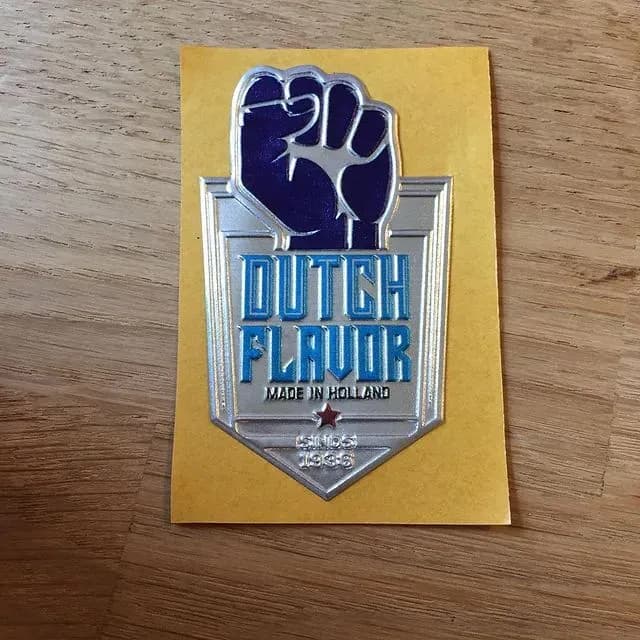
Industrial nameplates are durable, often metal plates that identify machines, equipment and installations. They show who the manufacturer is, what the serial or type number is, and which warnings or instructions apply. In Europe many of these are mandatory, think CE markings, energy labels or safety symbols. A nameplate must therefore not only remain clearly visible, but also withstand temperature changes, dirt and wear.
Key features
- Material: choose between 100% metal (tin, copper, brass or aluminium) as a flexible 1 mm label, or a coloured zinc alloy as a rigid 2–3 mm badge
- Thickness and flexibility: 1 mm metal labels bend with curves; 3 mm badges are rigid and only suitable for flat surfaces
- 3D relief: both have an embossed 3D effect, but it shows more strongly in the thicker, stiffer badge
- Mounting: labels stick with self-adhesive or a magnet; badges are fixed with a screw or bolt through a pre-drilled hole, or with adhesive
- Weather resistance: aluminium stays stable outdoors; tin, copper and brass oxidise over time, even with a protective layer
- Minimum order: metal labels can technically be under 250 pieces, but 250+ is usually cheaper per piece; hard badges start from 250 pieces
- Lead time: 4–5 weeks after approval of the free digital preview
- Price: metal labels from about €1.27 each (250 pieces) down to €0.60 (2,500+), excluding one-off die-cut costs

Materials: tin, copper, brass or aluminium?
Each metal has its own strengths and weaknesses. Tin gives a classic, silvery look and is relatively inexpensive, but it oxidises quickly outdoors, turning dark grey (patina). We therefore advise against tin outdoors without a printed protective layer. Copper offers warmth and a reddish-brown colour; copper also oxidises outdoors and turns greenish (malachite). For industrial outdoor environments it is less ideal. More guides on this topic are in the category Industry & stainless-steel marking.
Brass is a copper–zinc alloy and feels luxurious, but it also oxidises outdoors. For indoor use, such as on machines in a dry workshop, brass is a strong choice because of its golden tone.
Aluminium is your best choice outdoors. It stays stable, does not discolour and does not corrode like the other metals, even without a printed protective layer. In industry, manufacturers therefore increasingly choose aluminium, especially for outdoor installations.
A printed top layer (for example a fully printed surface) also protects: because the bare metal is no longer visible, it can no longer oxidise. But where metal remains exposed, around the edges for example, oxidation can still occur. Our experience: for long life without maintenance, aluminium is the safe choice with little effort.
Flexible or rigid? Your surface decides
The 1 mm metal label is flexible and bends along. That is crucial if you want to mount it on a curved surface, for example on a cylindrical drum, a round pipe or a motor with a convex housing. The adhesive makes good contact everywhere. Conversely, if you try to stick a rigid 3 mm hard badge onto a round form, it will not adhere everywhere and will appear to lift. All versions and prices are on the page 1 mm metal labels. All versions and prices are on the page 1 mm metal labels.

The 3 mm hard badge is either a plain rectangle or a strong, rigid shape. It works perfectly on flat surfaces, a control panel, a motor stator, a switchboard. The 3D relief stands out much more and looks professional and dignified. Also for very hot environments (above 80 °C) we recommend a hard badge, because the self-adhesive on labels can start to give way.
Our practical tip: if you doubt whether you want a label or a badge, ask yourself: is the surface curved or flat? Curved = label. Flat and you want something strong = badge.
Mounting: adhesive, screws or magnet
With metal labels you have three options: self-adhesive (Lohmann for aluminium/tin, 3M for copper/brass), via a magnet, or screw mounting. Self-adhesive is fastest and needs no holes, but only on clean, dry surfaces. On oiled wood, damaged or wet metal it adheres less well. Then we recommend using screws instead. Also read our guide on aluminium rating plates. Also read our guide on aluminium labels outdoors.
With hard badges you cannot use self-adhesive without issues; they are too rigid and heavy. Instead, drill a hole and insert a screw or bolt. That is strong and ideal for long life. Alternative: an industrial epoxy adhesive (much stronger than self-adhesive) or a magnet system if the surface is ferromagnetic.
Important: want to remove self-adhesive labels later? Use an adhesive remover (no sharp tools), then no adhesive residue or scratches remain.
Where industrial nameplates belong
In practice we see nameplates in almost every sector, from food industry to electricity. See our solutions for custom metal labels and find what fits your application. More background on stainless steel can be found on Wikipedia.

Machines and installations in factories
Rating plates on electric motors, compressors, pumps and transformers must last for years and remain clearly visible. Here manufacturers usually choose aluminium metal labels (outdoor installations) or hard badges on flat operating panels (indoors). Maintenance staff must be able to read the serial number and warnings quickly.
Equipment in harsh environments
Chemical industry, marine applications, oil and gas installations, that is where nameplates work under extreme conditions. High temperatures, salt water, aggressive fumes. An aluminium label with printed protective layer or a hard zinc badge withstands that better than other combinations. The zinc alloy does not rust; aluminium does not either. Both can last for decades.
Measuring devices and electrical circuits
On laboratory instruments, oscilloscopes, transformers and protective cabinet components you want clear, indelible marking. A fine, elegant metal label (tin or brass) gives that kind of equipment a professional look, as long as it remains for indoor use and not in the elements.
Volumes and prices: where is the break point?
Schild Inc. uses tiered pricing for metal labels. For 250 pieces you pay roughly €1.27 each (plus one-off die-cut costs). From 500 pieces it drops to about €0.75 each. As you go higher, 1,000, 2,500 pieces or more, it drops to €0.64 to €0.60 each. Those die-cut costs weigh less at larger volumes. Also read our guide on grades of stainless steel. Also read our guide on stainless steel rating plates.
Hard badges work differently: they have a minimum of 250 pieces. Below 250 is not feasible, because the casting mould setup is not viable under that. Hard badges are also usually more expensive per piece than labels; the manufacturing involves more hand work.
Important: always request a tailored quote. Size, shape, material and colour affect the price. We price the largest metal labels (up to 180–220 mm) per cm², which can work out differently than flat tier prices. And if you only need a few hundred, consider whether a test pack (50–100 pieces) is cost-effective, so you can test quality and fit before you order in full.
From our experience: more than 95% of our customers order again. That says something about what industrial nameplates must do: they must simply work, for years, without hassle.
Protection against oxidation and wear
Tin, copper and brass are beautiful metals, but they oxidise outdoors. You can do two things: first, choose aluminium. Second, add a protective layer. A matte coating (colourless, matt) protects reasonably; a glossy UV coating even better; a fully printed top layer best of all. But, and this is crucial, where the metal remains exposed (edges, corners), oxidation can still occur. That is not bad; it gives characterful patina. But on an industrial rating plate you usually want to avoid that patina.
Aluminium, on the other hand, oxidises differently. It develops a thin, non-degrading oxide layer and remains metallic and shiny underneath. In industry and for outdoor use that is your best option.
Conclusion
Yes, industrial nameplates are an essential part of professional machines and installations. Choose your metal and mounting based on your surface (curved or flat) and environment (indoor, outdoor, harsh). For outdoors and long life we recommend aluminium; for indoor use and elegance tin or brass; for very pronounced relief and strength a hard zinc badge. Do not wait until the nameplate is worn out: get it right from the start. Schild Inc. has produced metal labels and badges in the EU for more than ten years, since 2021 more than 800,000 pieces for over 1,200 business customers in 19+ countries. That track record speaks for itself.
