
What is stainless steel marking?
Stainless steel marking is a misunderstanding: you cannot make self-adhesive labels from stainless steel (RVS). Stainless is far too thick and stiff for the flexible 1 mm labels we produce, and not viable in small and medium runs. What does work are metal labels in aluminium, tin, copper or brass, and of those aluminium is the choice if you want stainless behaviour (no oxidation).
Key features
- Aluminium labels do not oxidise: stay unchanged for decades, even outdoors in rain and sun
- Real material thickness: aluminium 0.10 mm core + 1 mm relief/adhesive total; tin 0.16 mm core; copper and brass thinner
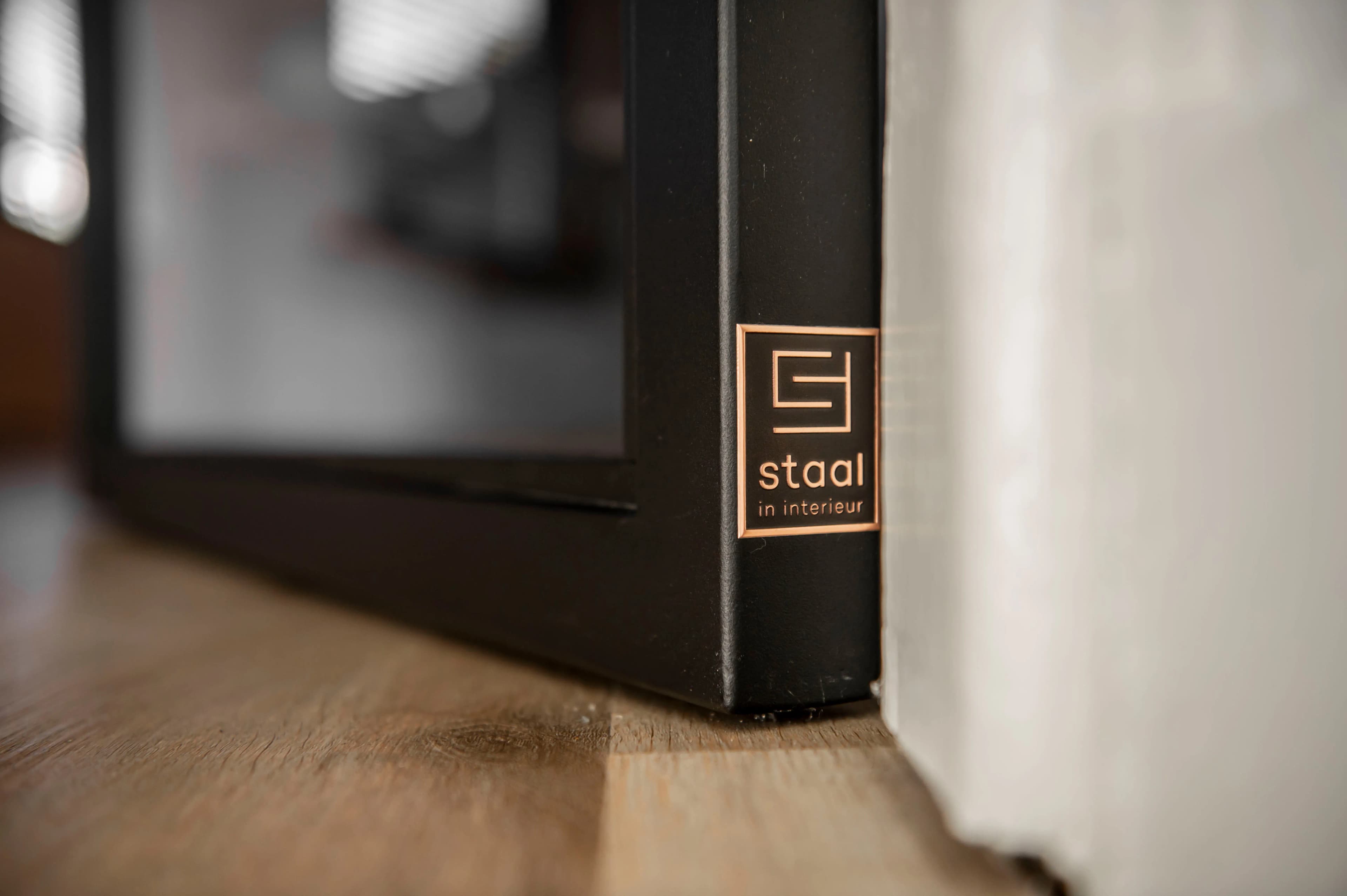
- Self-adhesive or magnetic: 1 mm thin and flexible, perfect for curved surfaces (frames, bottles, wood)
- Minimum run 250 pieces: unit price drops from ±€1.27 (250 pcs) to ±€0.60 (2,500+ pcs) for aluminium
- Yellow Lohmann adhesive for aluminium: German quality, sticks to non-porous and non-oiled material
- 3D relief: every label gets depth; the more contrast you choose between flat and relief, the stronger it shows
- Lead time 4–5 weeks: after approval of the free digital preview; no physical samples, but a sample pack is available
- Made in Europe: Schild Inc produces in Almere and has sold over 800,000 labels to 1,200+ customers since 2021

Why stainless steel is not the choice
Stainless steel (AISI 304 or 316) is an excellent material, but only in thicknesses of 0.5 mm and up. At those thicknesses it is far too stiff and too costly for self-adhesive branding labels. Also, if you really want “stainless” (no oxidation and no risk of discolouration), aluminium is the better choice. Aluminium costs less, is lighter, bends better with curved surfaces and stays unchanged for decades. More guides on this topic are in the category Industry & stainless steel marking.
From experience we know that when customers say ‘stainless’ they usually mean three things: durable, non-oxidising, and professional. Aluminium meets all three.
Aluminium: the truly ‘stainless’ solution
1 mm aluminium labels are the practical replacement for what you mean by ‘stainless marking’. The material has a natural resistance to oxidation, not because of a protective layer (although that exists), but because of the structure of aluminium itself. After years outdoors it stays grey-silver and does not change colour. All versions and prices are on the page 1 mm metal labels. All versions and prices are on the page 1 mm metal labels.

For outdoor use we especially recommend aluminium. A price example: an aluminium label of about 3.5 cm costs about €1.27 each at 250 pieces and drops to ±€0.60 each at 2,500 pieces (excl. one-off die-cut/print costs). The exact price depends on size, shape and quantity; a tailored quote gives full clarity.
The self-adhesive side uses yellow Lohmann adhesive, a German standard that bonds very well to non-porous material. On oiled or waxed wood we recommend screw mounting or a hard badge instead.
Tin, copper and brass: beautiful, but they oxidise
Tin, copper and brass give your label a more classic, warmer look. Tin has a silver sheen, copper a red glow, brass a gold-like tint. They are also 1 mm thick and flexible, identical to aluminium in that respect. Read our guide on industrial nameplates. Read our guide on aluminium label outdoors.
The difference: they oxidise. Tin becomes darker after months outdoors (patina effect), copper gets a greenish layer, brass browns. This is not bad, many designers like it, but it is not ‘stainless’. A protective layer slows this, but does not stop it completely. Where the metal is exposed (for example if you do not print the top layer fully), oxidation can still occur.
Indoors, or in sheltered spots (under a roof, behind glass), this is much less of a problem. And for products where patina is desired, for example on vintage furniture or design items, tin and copper are the choice.
The adhesive choice differs here: tin gets yellow Lohmann adhesive, copper and brass get 3M adhesive (for larger copper labels sometimes a thicker variant, because copper’s surface tension is higher and the edges can lift otherwise).
When you need a hard badge instead of a label
A hard badge (2–3 mm) is stiff and cast from a coloured zinc alloy, not solid precious metal, but an alloy that mimics the look. Badges do not have a self-adhesive side; you mount them via a drilled hole (with a screw/bolt through the hole) or with adhesive/magnet.

Use a badge if: your product is curved and the badge still needs to stay straight (for example on a curved frame, where a flexible label would work much better), or you want a very robust, non-bendable marking. View our custom metal labels and compare which option fits best.
Badges start at 250 pieces, no lower runs possible, otherwise casting costs become prohibitive.
Fixing: self-adhesive, screw or magnet
1 mm metal labels are almost always self-adhesive. The adhesive differs per metal (yellow for aluminium/tin, 3M for copper/brass), but surface preparation is crucial. Read our guide on aluminium nameplates. Read our guide on stainless steel nameplates.
In practice we recommend: More background on stainless steel can be found on Wikipedia.
- Clean surface: wipe it with an alcohol wipe (especially on plastic, wood or painted surfaces).
- Not on oiled or waxed wood: self-adhesive material bonds poorly there. Choose screw mounting (you can add screw holes to the label) or a hard badge.
- Press firmly: apply strong pressure for a few seconds so the adhesive makes good contact.
- Let it cure: wait 24 hours before you move the product or let water get on it.
Do you want to remove the label later? Use a sticker remover (not sharp tools) and no adhesive residue or scratches will remain. Aluminium and tin are very scratch resistant.
Who are metal labels for?
Bicycle manufacturers and sports brands
A bicycle frame is curved. A stiff 3 mm badge will not follow that curve; a flexible 1 mm metal label bends perfectly with it. This is why almost all bicycles use a metal label. .
Furniture and woodworking companies
Swedish design, Italian craftsmanship, furniture makers want their brand to show. An aluminium label on a black wooden table or chair radiates quality. Note: on waxed wood self-adhesive bonds less well; screw mounting is better. .
Perfume, cosmetics, wine and food & drink
Bottles are smooth and curved, aluminium labels are ideal here. They resist moisture, keep their shine, and give your flacon prestige. Labels for perfume bottles and labels for wine bottles are popular in the luxury and craft segments.
Musical instruments, candles and interior
Here the aesthetic goal sets your choice. Copper or brass labels add warmth on a wooden guitar; aluminium brings elegance on modern candles. Read more about labels for musical instruments and labels for candles.
Lead time and stock: what you need to know
Schild Inc. has no standard stock of cut and printed labels. Every order is made to measure. That is why the lead time is 4–5 weeks after approval of the free digital preview. Before we produce you always receive a digital mock-up for checking, no surprises on delivery.
The minimum run is 250 pieces. For small tests (50–100 pieces) metal labels have a test pack option for new customers, but the unit price is higher. At 250 pieces you are usually already better off.
Unfortunately hard badges cannot go below 250; they really start at 250 pieces due to casting costs.
Case study: Industrial Branding
A Dutch manufacturer of industrial machines wanted to brand its metalwork. They asked for ‘stainless steel nameplates’. We advised aluminium labels (flexible, no oxidation, cheaper than stainless) and hard badges as an alternative for places where absolute stiffness was needed.
They chose aluminium: 500 labels of 4×6 cm with zerfallen-relief, self-adhesive. Cost about €375 (€0.75/pc) plus one-off die-cut/print costs. After two years they report: no oxidation, labels still hold. They now order 1,000 pieces per year, cost dropped to ±€0.64/pc.
This example shows: if you thought you needed ‘stainless steel’, aluminium often works better and costs less.
Conclusion: aluminium is your answer to ‘stainless steel’
Yes, you can brand your product with durable, non-oxidising metal labels, but not from stainless steel itself. Aluminium is the practical, affordable replacement. It stays unchanged for decades, is flexible enough for curved surfaces, and costs less. Tin, copper and brass are beautiful, but oxidise outdoors. Choose aluminium and you get a label that never rusts and needs no maintenance.
Not sure which metal fits your product? A free tailored quote helps; you’ll see all options and prices.
