

Labels for handmade products: where does your brand start?
What are labels for handmade products? Labels for handmade products are metal or plastic nameplates that you attach to your own creations; they serve as signature, proof of origin and brand identity in one. For many craftspeople a good label is not just decoration; it is the quiet promise that this object was made with care. Schild Inc has since 2021 supplied over 800,000 metal labels to more than 1,200 business customers, many of them makers of furniture, candles, musical instruments and other handcraft. Choosing the right label is not only about beauty, but about material, durability and how it is fixed to your product.
Key points
- Metal labels are 1 mm thin and flexible, so they follow bends and curves without cracking, ideal for curved shapes like wooden furniture or bicycle frames.
- Hard badges are 2–3 mm thick and completely rigid, cast from coloured zinc alloy with a stronger 3D effect, suitable for flat, solid surfaces.
- 100% pure metal vs. alloy: metal labels are made from the metal you choose (tin, copper, brass or aluminium); hard badges are coloured zinc alloy that mimics the look of precious metal.
- Oxidation behaviour differs by metal: tin, copper and brass change colour outdoors after months to years (patina); aluminium stays stable and is the choice for outdoor use.
- Self-adhesive or mechanical: metal labels stick by themselves; hard badges are screwed (via a hole), glued or fixed magnetically.
- Minimum order: metal labels can start from smaller quantities (although 250 units is usually cheaper per piece); hard badges really start at 250 units.
- Lead time: 4–5 weeks after approval of your free digital preview; no physical samples, a sample pack is available.
- Price per metal label: about €1.27 at 250 units, dropping to €0.60 at 2,500+ units (exact price depends on size, shape and material).

Handmade means: choosing at the right moment
If you make handmade products, whether wooden tables, perfume bottles, knitted scarves or hand-bound books, you probably already know that the label is the last part of your story. It only looks right after months of work, so it must feel like a deliberate choice, not something you happened to buy somewhere. More guides on this topic are in the category Furniture & woodworking. Also read our guide on metal labels for furniture. Also read our guide on finishing a metal label.
In practice we advise makers to decide two things first:
- Where will the label go? On wood, plastic, paper, glass or textile, and is it on a flat surface or on a curve?
- How many pieces do you make per season? This decides whether you order 100 labels at a time or 500 at once.
Tin and copper look beautiful, but tin oxidises relatively fast outdoors, and copper turns green after a few months. Brass follows the same path. Aluminium, on the other hand, stays shiny. That does not mean it never changes, but it is much more stable. A protective layer helps, but where the metal is exposed (especially at edges), oxidation can still occur. Our experience: choose aluminium for products that end up outdoors or in damp rooms, and keep tin, copper or brass for interiors or where you want that natural patina to grow.
The difference between a metal label and a hard badge
The two main categories are the metal label (1 mm thin, flexible, self-adhesive) and the hard badge (2–3 mm thick, rigid, usually screwed). They both have a 3D relief, but the effect feels very different. All versions and prices are on the page 1 mm metal labels. All versions and prices are on the page 1 mm metal labels.

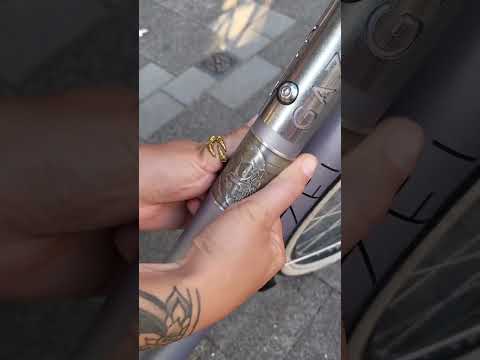
A metal label bends with your product; place it on a wooden bowl with a rounded rim, and it will follow that curve smoothly. This is why bicycle manufacturers always choose the label: a badge would never sit well on a curved bicycle frame. Material thickness differs per alloy: tin is 0.16 mm, aluminium and copper 0.10 mm, brass only 0.06 mm; the '1 mm' is the total thickness including relief and adhesive layer.
A hard badge, on the other hand, sits on flat surfaces. The relief is deeper and more visible because it is cast thicker. You do not fix it with adhesive alone, but with a bolt through a hole, or you stick it to a very clean, flat surface. On oiled or waxed wood self-adhesive sticks less well; there we advise a screw or a hard badge.
See our custom metal labels and find the size, shape and material that fit your product.
Choosing material: tin, copper, brass or aluminium
A considered choice for a metal label starts with the material. Each metal brings something different. Also read our guide on wooden labels vs metal labels. Also read our guide on furniture nameplate.
Tin: Shiny, classic, lighter than copper, perfect for a vintage or classic look. Oxidises outdoors after a few months to dark grey; many makers see this as patina and want it to happen. Ideal indoors; less suited outdoors unless you are fine with that darkening.
Copper: Warm, red-gold colour, premium feel. Oxidises after 6–12 months to green (classic oxidation). Many users like this; others want to prevent it with a printed top layer. Adhesive is 3M quality due to surface tension. Not ideal for very humid outdoor environments.
Brass: Yellow-gold tone, subtle, aristocratic. Oxidises slowly, later than copper. Also needs 3M adhesive. For very large labels (over 10 cm) we recommend a thicker Lohmann adhesive because brass is so thin that the edges can otherwise lift. Not a good long-term choice for outdoor use.
Aluminium: Silvery white, modern, extremely durable outdoors. Does not visibly oxidise (a micro-oxide layer protects the rest). Yellow Lohmann adhesive, perfect for products that end up in the garden, bathroom or sea air. Least 'warm' look, but unbeatable for stability.
Labels on wood and other base surfaces
Many makers work with wood; it is warm, natural, and the story of the label on the wood feels right. But wood is not all the same.

Oiled or waxed wood is a challenge for self-adhesive labels. The surface structure is too smooth or too porous, and adhesion is weak. Our advice: choose a mechanical fixing instead, a small bolt through the label and the wood, or choose a hard badge with two screw holes. On untreated, rough wood or lacquered wood metal labels stick very well. More background on woodworking you will find on Wikipedia.
If you want to remove the label later without scratches or adhesive residue, use a sticker remover (not sharp tools). This always works cleanly.
On paper, cardboard and other soft materials we recommend: make sure there is a hard layer underneath (for example a card layer between the label and textile), otherwise the label presses into the material and it will not look right.
Who is this for?
Furniture and woodworking makers
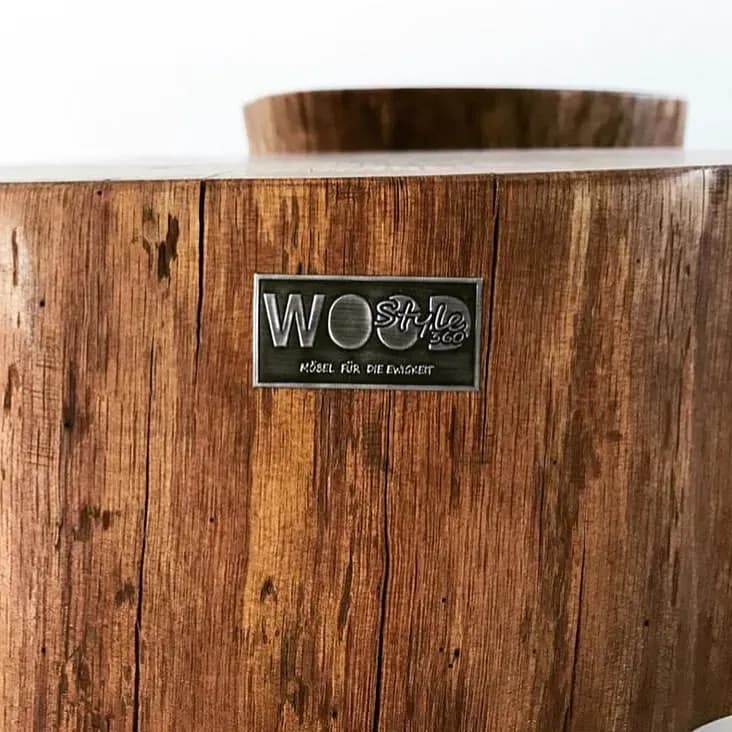
If you are looking for labels for furniture you are probably a furniture builder, joinery designer or workshop. A metal label on a bench or table leg is your signature. We recommend aluminium or tin on untreated or lacquered wood, and suggest screw mounting on oiled wood.
Makers of candles, fragrances and interiors
The world of labels for candles and interior objects is delicate, many makers use small labels on jam-jar-like containers. Here self-adhesive labels work perfectly, as long as the glass is clean and dry. Labels for perfume bottles can be metal (very premium, heavy) or have a printed top layer that protects the metal. Brass and copper give the nicest warm-gold effect here.
Musical instrument makers
Electric guitar makers, luthiers and other instrument builders see the label as part of the craft identity. On a headstock or tailpiece you can place a sizeable metal label; it looks serious and feels weighty. We recommend: labels for musical instruments, brass or tin, 3–5 cm size.
Sizing and mounting: practical guidelines
The largest metal labels we make are around 180–220 mm. For larger surfaces we calculate per cm² (about €0.04/cm²). Smaller labels are most cost effective; 3–5 cm is a good starting point.
Self-adhesive mounting requires a clean, dry, smooth surface. For curves, say in your order: 'label must bend', we will then match the right flexibility. Magnet mounting is a third option: with a magnet on the back you can reposition labels without damage. Ideal for customers who are experimenting.
Screw mounting costs extra (drilling two screw holes), but gives the most durable grip, especially on wood or plastic. For very hot and humid environments (sauna, bathroom) we advise screws or magnets over self-adhesive.
Costing and minimum quantities
At 250 units an aluminium label around 3.5 cm costs about €1.27 each. This drops quickly: at 500 units about €0.75, at 1,000 units €0.64, and at 2,500+ units around €0.60 each. These are indicative price examples; the actual price depends on exact dimensions, shape, colour and relief depth. Request a tailored quote or use the price calculator on our product page.
A common mistake: thinking that low quantities (50–100 units) are much cheaper than 250. The opposite is true; the price per piece goes up so much that 250 units almost always works out cheaper. Hard badges cannot go below 250 units; metal labels can, but then you pay much more per piece.
There is a one-off cost for making the die-cut (stamp). The digital preview is free, and you approve it before you place your order. Lead time is standard 4–5 weeks.
Conclusion: labels as part of your craft
Labels for handmade products are not just a cosmetic extra; they are your signature, your quality guarantee, your story in physical form. Yes, a metal label is the right choice if you make a product that bends (curved wood, frame building, textile), if you want to show premium material quality, and if you expect the product to last for years. No, if you need tens of thousands of labels per week and rock-bottom cost is crucial, then there are faster alternatives.
A quietly proud maker knows: the right label does the quiet work. It sits where it should, discolours elegantly or stays unchanged, and it still looks good tomorrow. Choose aluminium for outdoors, tin or copper for classic interiors, and make sure the surface is clean and the fixing is solid. Then you have a label that does your product justice.