

What are metal labels for furniture?
Metal labels for furniture are thin (1 mm), flexible self-adhesive brand marks made of real metal – tin, copper, brass or aluminium. A furniture maker sticks them on a tabletop, chair seat or cabinet door as a signature of craftsmanship. They give your work a professional finish and tell customers straight away: this is made with care.
Unlike a paper label, metal stays intact for years – even under hands, dust and light.
Key features
- Material: 100% real metal – no coating that imitates metal; the true thickness of the material varies (tin 0,16 mm, copper and aluminium 0,10 mm, brass 0,06 mm), but including the 3D relief and adhesive you end up around 1 mm.
- 3D relief: both the label and the badge have relief, but the label is thinner and subtler; the relief becomes more visible with more colour contrast.
- Flexibility: the 1 mm label bends with curves and curved surfaces – ideal for curved cabinet doors, ornate chairs or tabletops with a chamfer.
- Fixing: self-adhesive (with adhesive matched to the material), magnet-compatible, or screw mounting via a pre-drilled hole – no special tools needed.
- Minimum order: 250 pieces, but we offer new customers a test pack of 50–100 pieces for metal labels so you can see how it looks first.
- Lead time: 4–5 weeks after approval of your free digital preview; you see the design in advance, so no surprises.
- Price: an aluminium label of about 3,5 cm costs you roughly €1,27 each at 250 pieces and drops to about €0,60 each from 2.500 pieces (excl. one-off die-cut/printing costs).
- Colour & oxidation: tin, copper and brass can oxidise outdoors over time – aluminium is therefore the recommendation for outdoors; a printed top layer also protects, but then you do not or only partly see the bare metal.

Why furniture makers choose metal labels
For anyone who makes furniture, the label is like a signature. It sits small, subtle, yet unmistakable on your work. More guides on this topic are in the category Furniture & woodworking. Also read our guide on furniture nameplate. Also read our guide on finishing a metal label.
Real Schild customers in this sector – makers like Mon Atelier Connecté, Shira Living Design and Ombre & Luminare – choose metal because it:
- Lasts: no frayed corners or stains after a few years like paper.
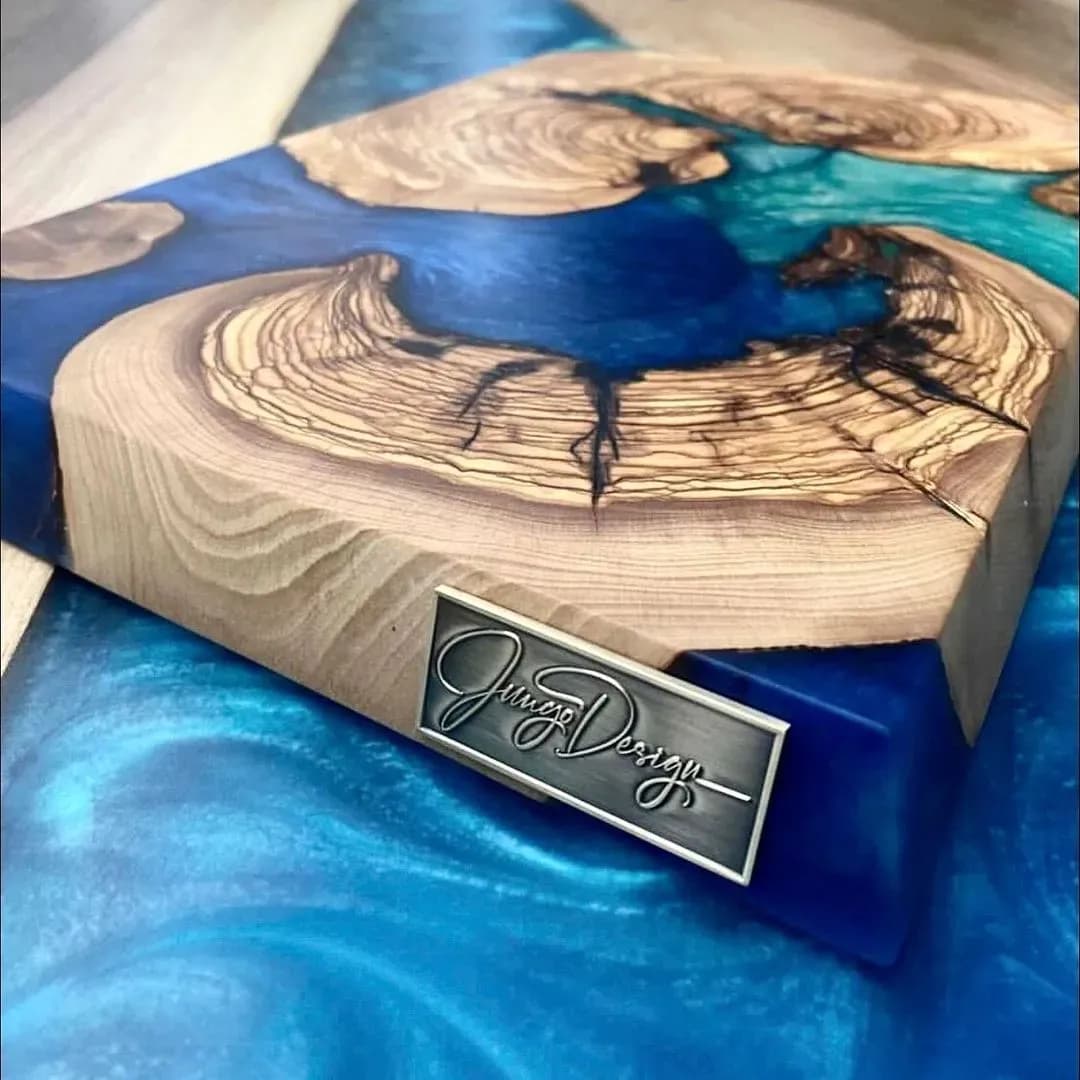
- Stays elegant: the 3D relief catches light – you see the depth, especially on wood.
- Convinces customers: metal feels like quality; it gives your brand more weight.
- Is flexible: because it is thin, it follows curved corners and tabletops – perfect for organic shapes.
From experience we know that a furniture entrepreneur who uses metal labels once then builds them in as standard. It is the small detail that makes the difference.
Which material should you choose for your furniture
Each metal has its own strengths. Here we help you on. All options and prices are on the page 1 mm metal labels. All options and prices are on the page 1 mm metal labels.

Aluminium is the most practical for furniture. It does not oxidise – no dark spots – and is lightweight. Perfect for modern design. Price: very economical (see price example above).
Tin looks classic and shiny – ideal for vintage or craft design. Outdoors it discolours over time (darker, a so-called patina). Indoors it stays nice much longer. Costs just a bit more than aluminium.
Copper gives a warm, luxurious feel. It also develops a patina outdoors, and that is the charm – an authentic green/brown layer. For indoor furniture a classic choice. Slightly more expensive than aluminium.
Brass is great for elegant pieces – glossy gold colour. It also oxidises outdoors, and that can also be attractive (dark brown). The thinnest material of the four (0,06 mm skin), so not suitable for very large labels (above ~180 mm it becomes too fragile).
Our practical rule: for indoor furniture choose what best fits your style; for outdoor furniture (garden chairs, benches) we recommend aluminium.
How to apply the label properly
Most mistakes happen when sticking. They do not have to. Also read our guide on wooden labels vs metal labels. Also read our guide on labels for handmade products.
Self-adhesive works best on clean, dry wood without oil or wax. Oiled or waxed wood? Then the adhesive bonds less well – in those cases we recommend screw mounting (via the pre-drilled hole) or choose a hard badge, which is more stable on smooth surfaces.
- Clean the surface with a dry cloth (no water or oil).
- Place the label carefully, start from one corner.
- Press down gently – no brute force, just steady pressure.
- Let it rest for 24 hours before you move the piece of furniture.
The adhesive differs by material: aluminium and tin get a yellow Lohmann adhesive (German quality), copper and brass get 3M adhesive. We have already set that for you – you do not need to do anything yourself.
Remove a label later? Use a sticker remover (no sharp knives or scraper). Then no adhesive residue or scratches remain.
Size, shape and price of your label
Most furniture labels are small – around 3–4 cm – because they are a signature, not an advert. We make labels up to about 180–220 mm; above that we calculate per cm² (about €0,04 per cm²). More background on woodworking is on Wikipedia.

The shape can be square, round, oval or fully custom – for example a logo shape. Every shape has the same production costs; the price depends on material, surface and quantity.
View our custom metal labels and configure your own design.
Price example: 250 pieces aluminium, 3,5 cm square, €1,27 per piece (total: about €318). At 500 pieces it drops to €0,75 each (about €375 total). The larger your run, the better the price – and 250 pieces is usually the break-even point for small makers.
Who are metal labels suitable for?
Craft furniture makers
You make tables, chairs, cabinets – preferably bespoke or limited edition. Metal labels are your way to say: this is my work. Many makers in this segment work with labels for furniture as a standard feature on every piece.
Interior brands and design studios
You have furniture produced and want your own branding on it. Metal labels give your collection a uniform, professional look and are much cheaper than full custom manufacturing.
Furniture finishers and restorers
You give vintage pieces a second life – a metal label shows that you restored them. It adds value and makes the difference between an unknown piece and a recognised restoration.
Comparison: label vs badge vs alternatives
We supply two main products for furniture:
Metal label (1 mm) – flexible, self-adhesive, subtle relief. Ideal for wood, fabric and curved shapes.
Hard badge (3 mm) – rigid, cast from coloured zinc alloy, stronger relief. Better for very flat, strong substrates (for example polished metal or hard plastic).
The label is thinner and flexible; the badge is thick and rigid. For furniture almost everyone chooses the label, because furniture often has rounded edges – the flexible label follows that naturally, while the rigid badge does not sit well on it.
Alternatives are paper stickers (cheap, but fail quickly), engraved plates (expensive, fixed) and direct print on wood (scratches and fades). Metal sits in the middle – affordable, durable, elegant.
Practical tips from our workshop
- Small test: ordering 100–250 pieces first? Fine. We give you a free digital preview, so you are sure it looks the way you want before we start production.
- Large surface: if your label gets bigger (>10 × 10 cm), think about whether you want a large copper or brass label – those can sometimes be much heavier and costlier. Aluminium is lighter and more budget-friendly for large sizes.
- Relief contrast: you see the 3D effect better when there is a lot of contrast between the relief and the flat areas – so white relief on dark, or the reverse. Ask us for advice with your preview.
- Supplier relationship: since 2021 we have delivered over 800.000 metal labels to 1.200+ business customers in 19+ countries. 95% order again. You are not alone.
Conclusion: metal labels for furniture – yes, if you want to show craftsmanship
Yes – if you make furniture and want customers to see that you stand behind it. Metal labels are not expensive, stay beautiful for years and give your work instant class. We help you at every step: design, material, size and price. Send your idea, we will give you a no-obligation quote.
