

Wooden labels vs metal labels: what is the difference?
Wooden labels and metal labels are both popular for product branding, but they serve different purposes. A wooden label is made from real veneer, maple, cherry or birch, and is printed or laser-engraved. A metal label is made from 100% metal (tin, copper, brass or aluminium) and is only 1 mm thin and flexible. The choice depends on the material you apply the label to, the durability you need, and your visual preference.
Key features
- Wooden labels: veneer 0.5–0.7 mm thick, self-adhesive, printed or laser-engraved, each label slightly unique due to natural wood grain
- Metal labels: 1 mm thin, flexible, self-adhesive or magnetic, durable for outdoor use (with aluminium), exactly reproducible
- 3D effect: both have relief, metal is more clearly visible
- Minimum order: both practically start around 250 pieces; lower quantities are possible but more expensive per piece
- Metal fixing: self-adhesive (standard), magnet, or mechanical (screw)
- Wood fixing: self-adhesive on smooth surfaces; on oiled or waxed wood we recommend mechanical mounting or a hard badge
- Lead time: both 4–5 weeks after approval of the free digital preview
- EU production: both made in Europe (head office Almere, Netherlands)

Wooden labels: warmth and uniqueness
Wooden labels appeal because they have a natural, warm look. Each label is slightly different due to the wood grain, which is an advantage if you want to express an organic, handcrafted identity. That is not a coincidence, but a deliberate choice of material. More guides on this topic are in the category Furniture & woodworking.
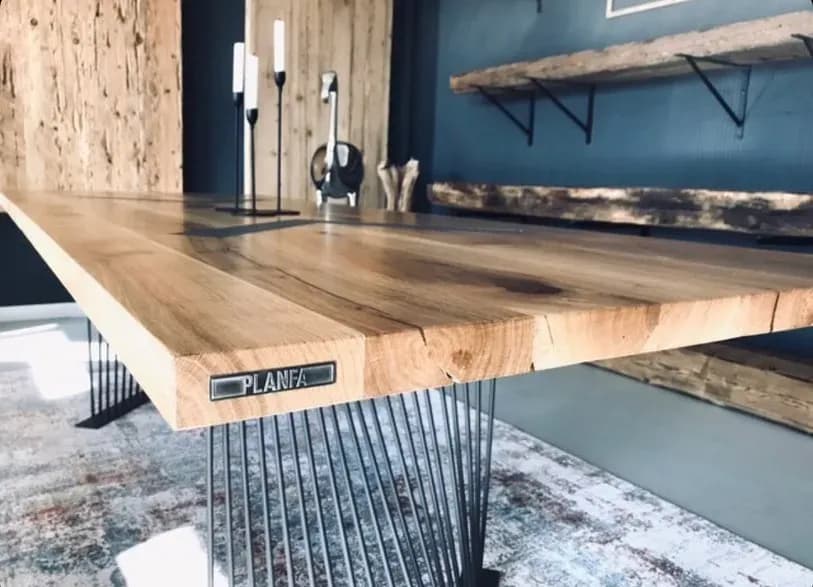
The veneer is extremely thin (0.5 mm for printed, 0.7 mm for laser-engraved) and bends in one direction with the object you apply it to. That is why it is important to specify your orientation clearly when you order. In practice, makers in sectors such as furniture, interiors and candles like to use wooden labels as the brand’s signature, especially on dark or natural wood.
A common mistake is assuming wooden labels are as durable as metal. They are not suitable for long-term outdoor use or damp environments. Rain, extreme temperature fluctuations and direct sunlight degrade the wood. Indoors or in sheltered places (for example under a canopy) you can enjoy them for years.
Metal labels: flexibility and durability
Metal labels are thinner (1 mm) and fully flexible. They follow the curve of almost any surface, from a curved bicycle mudguard to a round bottle. This makes them ideal for products with non-flat shapes. They are also robust: metal resists moisture, temperature and UV radiation (provided you choose the right metal). All versions and prices are on the page wooden labels. All versions and prices are on the page wooden labels.

There are four metallic options: tin, copper, brass and aluminium. Our advice if in doubt: choose aluminium if the label will be outdoors. Tin, copper and brass oxidise outdoors over time, despite the protective layer. That does not look bad (we call that patina), but if you want to keep a shiny surface, aluminium is your best choice. From experience we know that customers in industrial sectors and for outdoor applications almost always choose aluminium.
Metal labels are exactly reproducible. That means all pieces are identical, with no natural variation. That is an advantage if you want to project consistency and quality assurance.
Fixing: how to apply the label
For wooden labels, self-adhesive is standard. But note: on oiled or waxed wood, self-adhesive sticks less well. In that case we recommend screw mounting, or you can switch to a hard badge (3 mm thick, rigid, with a pre-drilled hole for a screw). Read our guide on metal labels for furniture. Read our guide on labels for handmade products.
With metal labels you can choose. Self-adhesive is most common and all you need to do is remove the protective film and apply the label directly. Aluminium and tin get Lohmann adhesive, copper and brass get 3M adhesive, already on the label. Other options are magnet (for iron surfaces) or mechanical fixing with a small screw.
Remove the label later. Use an adhesive remover (carefully, no sharp tools) and you can lift the label off cleanly without scratches or adhesive residue.
The role of surface and shape
The choice between wood and metal strongly depends on where you apply the label. If the surface is curved or round, think of bike labels and accessories or bottles, then a metal label is the only option. A bicycle manufacturer always chooses the metal label, never the badge: a frame is curved and only the flexible 1 mm label follows that curve.

If the surface is flat and smooth, such as a wooden furniture panel, a candle cabinet or a perfume bottle, then you have both options. Here taste plays a role. For labels for furniture we see many wooden labels with makers who want a natural, handcrafted look, and metal labels with companies that feel more industrial or minimalist. The same choice applies to labels for perfume bottles and labels for wine bottles. More background on woodworking can be found on Wikipedia.
View custom wooden and metal labels for your product and get advice based on your surface.
Price and minimum runs
Wooden labels start at about €0.49 each (small printed label 21×28 mm). A medium laser-engraved label around 42×50 mm costs about €0.95 each, and a large printed label (45×90 mm) about €1.60 each. These are example prices for standard sizes. Read our guide on furniture nameplate. Read our guide on metal label finish.
Metal labels start in the same price range and can be just as cost-effective, depending on shape, engraving and metallic finish. For both: the more pieces, the lower the price per piece. If you want to order under 250 pieces, you can, but the price per piece then rises sharply. At 250 pieces you usually get the best value.
Schild Inc. works with a minimum order of 250 pieces and offers a test pack of 50–100 pieces for new customers (metal labels only). These help you determine whether the product fits well. Always request a free quote: we calculate exactly for your size, material and quantity.
Who is it for?
Wooden labels: makers and interiors
Wooden labels fit perfectly with artisanal brands, local makers and companies in the design and interiors world. Customers such as Mon Atelier Connecté, Shira Living Design and Ombre & Luminare use wooden labels as a signature. They work well on solid wood, painted wood or cardboard, materials where you want the label to stand out. For labels for candles and labels for musical instruments choose wooden labels if you want to convey warmth and authenticity.
Metal labels: industry, outdoor use and flexibility
Metal labels are essential for products that stand outdoors, are moved a lot, or where you need extreme durability. Bicycle manufacturers, wine and drinks brands, and industrial applications rely on metal. Aluminium is your best choice outdoors.
Hard badges: solid, non-bendable solution
A hard badge is not a label, it is a cast zinc alloy 2–3 mm thick with a pre-drilled hole. You screw it on, or stick it with adhesive. Badges cannot be under 250 pieces, they really start from that quantity. Badges are suitable for heavy industrial marking and where you want an absolutely indestructible identity.
Conclusion: choose based on purpose and surface
Yes, choose wooden labels if you want a warm, handcrafted identity, the label goes on a flat, smooth surface (wood, cardboard, stone), and it is for indoor use only. No, if you work outdoors, have curved surfaces or need extreme durability.
Yes, choose metal labels if you want flexibility, durability and exact reproducibility, work outdoors or in damp environments, or have round and curved shapes. No, if your budget is very tight and you are happy with paper or plastic labels (which we do not make, but your competitor does).
In practice, we recommend: first decide where and how the label will be used. Then see which materials and sizes fit. Request a quote with a free digital preview, so you know exactly how it looks before you pay. Schild Inc. has been working since 2021 with over 1,200 business customers in 19+ countries, and 95% order again. A 4.8-star rating on Google says enough about quality and reliability.
